Every experienced cook knows that browning food changes it.
The crust on a loaf of bread. The deep mahogany surface of a slow-roasted lamb shoulder. The golden edges of softened onions. The smell of roasting vegetables filling a cold kitchen on a grey May afternoon.
These aren’t just pretty — they’re the result of a complex and beautiful piece of chemistry happening right there in your pan. And once you understand it, you stop following recipes blindly and start cooking by principle.
What Is the Maillard Reaction
Named for French chemist Louis-Camille Maillard, who first described it in 1912, the Maillard reaction is a chemical reaction between amino acids (the building blocks of protein) and reducing sugars (simple sugars like glucose and fructose) that occurs when food is exposed to sufficient heat.
The reaction typically begins at around 140°C and is most active between 140°C and 165°C — which is why it only happens with dry-heat cooking methods like frying, roasting, grilling, and baking. It cannot occur in boiling water, because water caps the surface temperature of food at 100°C. Not hot enough.
What the reaction produces is not one compound but hundreds — pyrazines, furans, thiophenes, and more — each contributing to what we collectively recognise as browned flavour: roasted, nutty, savoury, complex.
This is the chemistry behind the smell of fresh bread. The richness of a slow braise. The deep satisfaction of a properly made winter stew.
The Numbers Worth Knowing
| Maillard browning begins | ~140°C |
| Optimal browning range | 140°C – 165°C |
| Caramelisation (sugars only, no protein needed) | ~160°C – 180°C |
| Boiling point — browning stops here | 100°C |
Why We Sear Before the Slow Cooker
This is the most common application of Maillard knowledge in the home kitchen — and one that many cooks do out of habit rather than understanding.
When raw meat goes straight into a slow cooker, it will cook through safely. It will be tender and moist. But the surface will be grey and flavourless, because the long, moist, low-temperature cooking environment never allows it to reach 140°C.
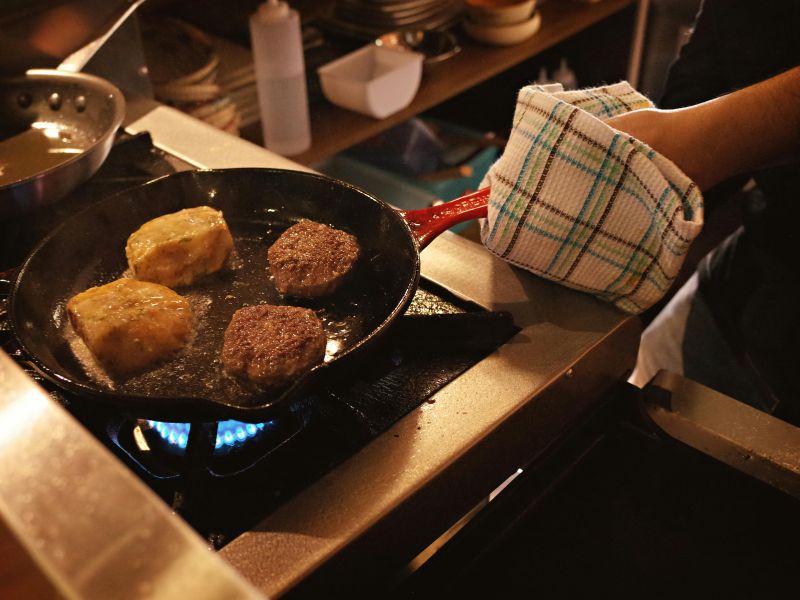
Searing first — in a hot, dry pan, before any liquid is added — creates the crust. You’re generating hundreds of complex flavour compounds in a matter of minutes that simply cannot form in a slow, wet environment.
Here’s how to do it properly:
Step 1 — Dry the surface. Pat the meat (or vegetable) completely dry with paper towel before it goes near the pan. Surface moisture creates steam, which keeps the surface temperature at 100°C — exactly where you don’t want it.
Step 2 — Hot pan, minimal fat, don’t move it. Heat your pan until it’s genuinely hot before adding any oil. Use a high smoke-point fat — beef dripping, ghee, or sunflower oil — and let it shimmer. Place your ingredient in the pan and leave it alone. The initial sticking is the Maillard reaction forming. When the crust releases naturally, it’s ready to turn.
Step 3 — Deglaze and capture every molecule. When you lift the seared meat from the pan, what remains on the base is a concentrated deposit of Maillard compounds — browned protein and sugar complexes of extraordinary flavour intensity. This is called the fond.
Deglazing — adding a cold or room-temperature liquid (wine, stock, water, or a splash of cider vinegar) to a hot pan — dissolves the fond through the combined action of temperature shock and liquid chemistry. Scrape vigorously with a wooden spoon. Every bit of that fond incorporated into your sauce or braising liquid adds deep, complex flavour that cannot be manufactured any other w
The Winter Secret: Vegetarian Umami Through Chemistry
Here is where this science becomes particularly powerful for the plant-based or meat-reduced home cook.
Umami — the fifth basic taste, often described as savoury, deep, and mouth-filling — is closely associated with glutamate, an amino acid found in meat, aged cheese, tomatoes, mushrooms, miso, and soy sauce. But you don’t need meat to generate Maillard-driven umami. You need amino acids and reducing sugars exposed to high heat.
Root vegetables — parsnips, sweet potatoes, celeriac, beetroot, carrots — contain both. When roasted at high heat in a dry pan or in an oven above 200°C, they undergo a vigorous Maillard reaction that produces deeply savoury, complex flavour compounds with a richness that rivals meat-based dishes.
This is the method:
- Roast your root vegetables in a hot oven (220°C) until deeply caramelised and charred at the edges. Don’t rush this step.
- Add a tablespoon of tomato paste to the pan and cook it dry over high heat for 60–90 seconds, until it darkens and smells roasted. That’s Maillard happening to the tomato proteins and sugars.
- Add a splash of soy sauce or a teaspoon of miso paste — both are fermented foods rich in free glutamates that amplify the savoury compounds.
- Deglaze with stock or water and scrape up every bit of fond.
- Add a handful of dried mushrooms to the braising liquid — they release glutamic acid as they rehydrate, deepening the umami further.
The result is a stew with a richness and depth that satisfies in the way a meat braise does — not because anything has been faked, but because the underlying chemistry has been correctly applied.
Cook by Principle, Not Just by Recipe
The value of understanding the Maillard reaction isn’t academic — it’s deeply practical. Once you know that browning requires a dry surface, sufficient heat, and the presence of both protein and sugar, you make different decisions at the stove.
You dry your meat before searing — not because the recipe says to, but because you know why it matters. You build your onions properly before adding liquid. You cook tomato paste before adding stock, not as an optional step, but as a necessary one. You reach for the cast iron over the non-stick when you want a proper crust, because a heavier pan holds heat better and gives browning a chance.
This is what Scientific Cottagecore means in practice. Not cold laboratory precision. The warm confidence that comes from understanding why the old ways work — and knowing exactly how to make them work for you, in your kitchen, in your winter.
With Warmth
Marlé