Stand at the till long enough and you will feel it. The number keeps climbing before you have even reached the end of your trolley. You put things back. You swap the branded item for the no-name. You do the mental arithmetic in your head and still come up short.
South African families are under real financial pressure right now. Food prices have risen sharply over the past five years, and the increases are not slowing down. Bread, cooking oil, maize meal, flour — the basics that every kitchen depends on are costing more than they ever have. And for most households, salaries have not kept pace.
But here is what I have learned, and what I want to share with you today: a well-built pantry is one of the most powerful tools a South African family has against rising food costs. Not a fancy pantry. Not an Instagram pantry. A smart one. One that is stocked with intention, restocked with a system, and used with purpose.
This is not about spending more money. It is about spending the money you have far more wisely.
Why Your Pantry Is a Financial Tool
Most of us think of the pantry as a storage space — a cupboard where tins and packets live until we need them. But a well-stocked, well-managed pantry is something much more valuable than that.
When your pantry is working properly, you shop from it first and the supermarket second. You plan meals around what you already have. You buy in bulk when prices are low and use from your stores when prices spike. You waste almost nothing because you know what you have and how to use it.
A reactive kitchen — one where you buy what you need meal by meal, trip by trip — almost always costs more. It means last-minute shopping, buying small quantities at full price, and too often falling back on expensive convenience food when the cupboard looks bare and time is short.
A proactive pantry changes all of that. It gives you options. It gives you breathing room. And in a season where every rand counts, it gives you real financial resilience.
The South African Cost of Living Reality
Let us look at where things actually stand. The average household food basket for a family of four in South Africa now exceeds R6,000 per month — and that figure has climbed more than 60% over the past five years. Bread and cooking oil prices have been particularly volatile. Fuel price increases push up the cost of transport, which pushes up the cost of everything on the shelf.
VAT increased in 2025 and again in 2026. Global supply chain pressures continue to affect what we pay for imported goods. And for most South African households, these increases have arrived without matching increases in income.
This is not a comfortable picture. But understanding it is the first step to responding to it intelligently — and building a pantry that acts as a genuine buffer between your family and those price swings.
The Four Layers of a Smart South African Pantry
A smart pantry is not built overnight, and it does not require a large upfront spend. It is built in layers, over time, with purpose. Here is how to think about it.
Layer 1 — The Foundation (Long-Life Staples)
These are the ingredients that form the backbone of almost every meal your family eats. They have long shelf lives, store easily, and provide the best value when bought in bulk during specials.
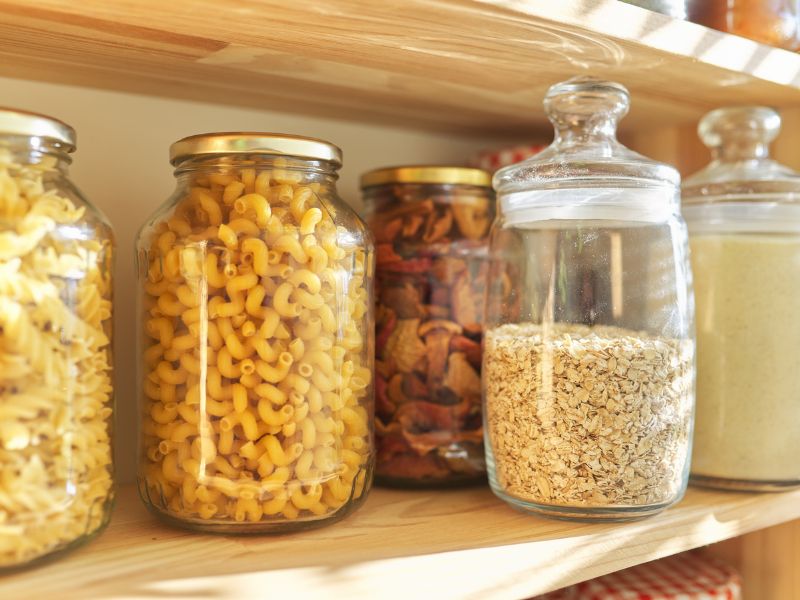
For a South African kitchen, your foundation layer should include: rice, maize meal, cake flour, self-raising flour, rolled oats, dried lentils, dried beans, split peas, sugar, salt, cooking oil, vinegar, bicarbonate of soda, baking powder, and a core selection of dried herbs and spices.
These items do not need to be bought all at once. Add two or three to your trolley each month when they are on special, and within a few months your foundation layer will be solid.
Buy these from wholesalers like Makro or Game when possible, or take advantage of Shoprite, Checkers, Pick n Pay and SPAR specials and loyalty programmes to stock up at reduced prices. Store in sealed glass jars or airtight containers in a cool, dark cupboard.
Layer 2 — The Working Layer (Weekly Use Items)
This is what you reach for every day — the fresh and semi-perishable items that rotate in and out of your kitchen regularly. Eggs, butter, milk, fresh vegetables, seasonal fruit, garlic, onions, potatoes and sweet potatoes belong here.
The key to this layer is buying seasonally. Seasonal produce in South Africa is dramatically cheaper than out-of-season items. In autumn and winter, look for pumpkin, butternut, sweet potato, cabbage, carrots and citrus — all of which are abundant, nutritious and affordable in this season.
Buy your working layer weekly, plan meals around it, and waste nothing. Wilting vegetables go into soup. Overripe fruit becomes a crumble or jam. A chicken carcass becomes stock. This is the mindset of the smart pantry — nothing leaves your kitchen until it has given everything it has.
Layer 3 — The Preservation Layer (What You Make Yourself)
This is where Hearth & Larder lives, and where the real savings begin.
When you learn to preserve food at home — whether that is bottling tomatoes in summer, making jams from seasonal fruit, fermenting vegetables, drying herbs or canning produce — you begin to build a pantry that is stocked with food you made yourself, at a fraction of the shop price.
A jar of homemade tomato relish costs a fraction of the branded version. Preserved peaches from summer cost almost nothing compared to buying canned fruit in winter. Dried herbs from your own garden or windowsill cost nothing at all.
The preservation layer also protects you against price spikes. When you have a shelf of home-preserved goods, a bad month at the shops does not empty your kitchen — because your kitchen is already full.
We go much deeper into preservation in an upcoming post. If you are ready to start now, our canning and preservation kits are designed to teach you the skill from scratch, with everything you need included.
Layer 4 — The Emergency Layer (A Three-Week Buffer)
The fourth layer is simple: always try to maintain a three-week buffer of your foundation staples. This means you are never shopping from a position of desperation. You are never buying at full price because you ran out. And if an unexpected expense hits — as it so often does — you can reduce your grocery spend for a few weeks without your family feeling it.
This layer does not require a big investment. It is built gradually, one extra packet of rice at a time, one extra tin of tomatoes when they are on special. Over a few months, it becomes a genuine cushion.
A Simple System for Restocking Your Pantry
Having a pantry is one thing. Maintaining it is another. Here is the simple system I use and teach.
Once a week, do a quick pantry scan before you write your shopping list. Note anything that is running low. Check what you have and plan your meals around it — rather than planning meals and then buying everything from scratch.
Once a month, do a proper pantry audit. Check expiry dates. Rotate stock so older items are at the front. Note what you have used most and make sure it is replenished. This monthly check also ties into The Homemaker’s Almanac — your monthly guide to what needs to happen in your home and kitchen for that particular season.
Once a season, review your preservation layer. What can you make before the season changes? What fresh produce is abundant and cheap right now? Autumn in South Africa is the ideal time to preserve — quinces, pears, tomatoes, stone fruit, and the last of the summer’s bounty are all available and affordable. Use them.
What a Smart Pantry Actually Feels Like
I want to paint you a picture of what life looks like when your pantry is working.
It is a Thursday evening and you are tired. You open the fridge and it is not full. But you open the pantry and you have options. You have lentils, tinned tomatoes, garlic, spices and pasta. Dinner is a fragrant red lentil pasta that takes twenty minutes and costs almost nothing. Your family eats well. There is no panic, no takeaway, no guilt.
That is what a smart pantry gives you. Not perfection. Options. And in the kitchen, options are everything.
Start Where You Are
If your pantry is currently a chaotic jumble of half-empty packets and forgotten tins, do not be discouraged. Every well-stocked pantry started exactly there.
Pick one section. Pull everything out. Check dates. Group like items together. Write down what you have. Then, this week, add two or three foundation staples to your shopping list.
That is the beginning. Small, intentional, and completely achievable.
If you want a framework for how your whole home — kitchen, pantry, rhythms and all — can run with less overwhelm and more intention, start with this post. And when you are ready for the tools and kits to help you take the next step in your kitchen, we are here to help and support you!
Your pantry can be one of the most powerful things in your home. Download your Free Pantry Staples Checklist here and let’s start building it together!
With Warmth,
Marlé